The World’s Most Expensive Fragrance Ingredients
When people think of luxury fragrance, they often picture beautiful bottles with designer labels. While those elements may contribute to the marketing, what truly makes a fragrance luxurious, and often expensive, are the ingredients themselves.
Fine perfumery has always relied on materials that are difficult to obtain. Some require years of cultivation before they can be used. Others depend on harvesting techniques that have remained largely unchanged for centuries. A few are so rare and coveted that they have become the stuff of legend, fragrant treasures tied to ancient civilizations, distant landscapes, and journeys of discovery that seem drawn from the pages of an archaeological adventure.
From precious resins and rare flowers to ingredients once worth their weight in gold, the world of perfumery is filled with remarkable materials. Here are some of the most fascinating, sought after, and expensive ingredients used in fragrance, and the reasons perfumers value them so highly.
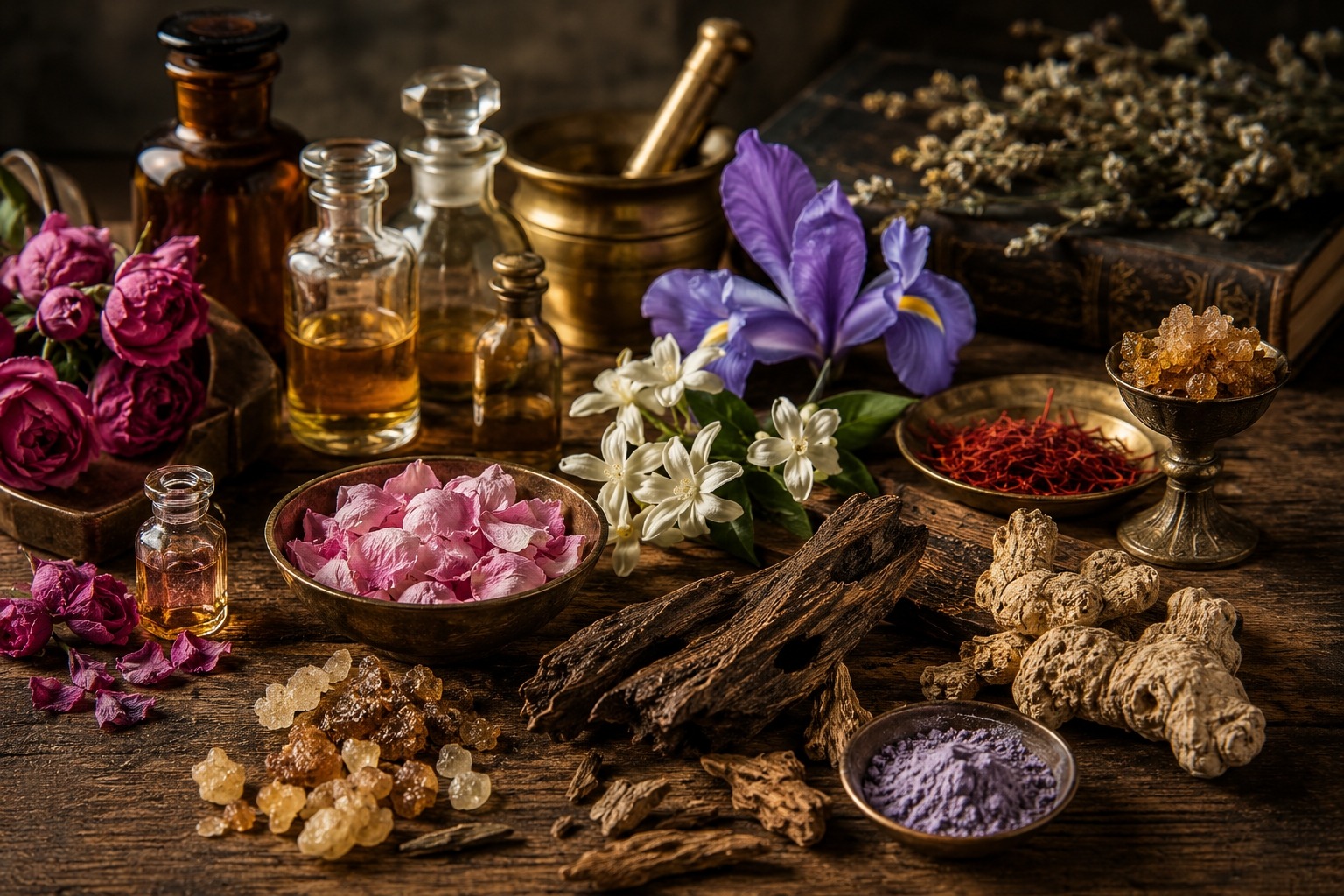
Oud: Liquid Gold
Few ingredients have achieved the status of oud.
Produced when certain agar wood trees develop a natural infection, the tree responds by creating a dark, fragrant resin. Over time, that resin transforms the wood into one of the most prized materials in perfumery.
Not every tree produces oud, and the process can take decades.
The result is a rich, complex aroma that has been treasured throughout the Middle East and Asia for centuries.
Orris: The Patience Ingredient
Orris comes from the root of the iris plant, but harvesting it is only the beginning.
After being dug up, the roots must be dried and aged for several years before their characteristic scent develops. Only then can they be processed into one of perfumery’s most luxurious materials. Soft, elegant, and often described as powdery or violet-like, orris is famous not only for its beauty but also for the patience required to produce it.
Rose: More Precious Than You Think
A rose may seem ordinary until you learn how much work goes into producing its essential oil.
Thousands upon thousands of blossoms must be harvested, often by hand, before sunrise when their fragrance is strongest.
It takes an astonishing quantity of petals to produce even a small amount of oil.
The next time you see rose listed in a fragrance, remember that you’re experiencing one of perfumery’s most labour-intensive ingredients.
Jasmine: Harvested One Flower at a Time
Jasmine has captivated people for centuries.
Its rich floral aroma appears in countless fragrances, yet producing jasmine absolute requires enormous effort.
The delicate flowers are often gathered by hand and must be processed quickly before their scent fades.
The result is an ingredient that perfumers continue to prize for its depth, warmth, and beauty.
Ambergris: The Legend
No discussion of expensive fragrance ingredients would be complete without ambergris.
For centuries, this mysterious material was one of the most sought-after ingredients in the world. Found floating at sea or washed ashore after originating in sperm whales, ambergris develops its distinctive character through years of exposure to the elements.
While modern perfumery typically relies on ethical alternatives, ambergris remains one of the most famous ingredients in fragrance history.
Frankincense: The Resin That Built Trade Routes
Few fragrance ingredients have a history as rich as frankincense.
For thousands of years, this aromatic resin was transported across deserts and oceans, traded alongside gold, spices, and precious textiles. Ancient civilizations burned it in temples, used it in ceremonies, and prized it as one of the most valuable commodities in the known world.
What many people don’t realize is that there isn’t just one type of frankincense.
Different species of Boswellia produce resins with distinct aromatic profiles.
Boswellia sacra, found primarily in Oman and Yemen, is often considered among the most prized. It produces a bright, refined aroma with citrus and slightly green nuances.
Boswellia carterii, traditionally associated with Somalia, offers a classic frankincense character that balances fresh citrus notes with warm resinous depth.
Boswellia frereana, sometimes called “Maydi” frankincense, is known for its smoother, richer aroma with hints of spice and wood.
Boswellia serrata, native to India, tends to be earthier and more robust, making it popular in both traditional medicine and fragrance applications.
Despite their differences, all frankincense varieties share a distinctive character that is at once fresh, resinous, uplifting, and timeless.
Saffron: Red Gold
Few ingredients are as instantly recognizable, or as labour-intensive as saffron.
Derived from the delicate stigmas of the saffron crocus, each flower produces only three threads, all of which must be harvested by hand. It can take tens of thousands of flowers to produce a single kilogram of saffron. The result is one of the world’s most expensive agricultural products.
In fragrance, saffron contributes a warm, exotic character that can be leathery, spicy, slightly sweet, and surprisingly complex. It has been prized for centuries not only for its aroma but also for its role in trade, medicine, textiles, and cuisine.
Like many of perfumery’s most treasured ingredients, saffron reminds us that true luxury often comes not from rarity alone, but from the extraordinary amount of time and craftsmanship required to produce it.
So What Makes an Ingredient Valuable?
Sometimes it’s rarity.
Sometimes it’s the amount of labour involved.
Sometimes it’s the years required before an ingredient is ready to use, and sometimes it’s simply the beauty of the scent itself.
Yet expensive ingredients alone don’t create great fragrances.
A masterfully blended perfume can be built from surprisingly simple materials, while the rarest ingredients in the world can fall flat if used without skill or purpose.
In the end, even the rarest ingredients are only part of the story. Exceptional materials provide the foundation, but it is the perfumer’s skill in blending them that creates something truly remarkable. In a world increasingly driven by speed and convenience, there is something special about materials that refuse to be rushed.
Perhaps that’s part of their appeal.
Behind every bottle of North Star Fragrance lies a story of patience, craftsmanship, and discovery, and sometimes, the most precious ingredient of all isn’t the rarest one. It’s the time required to create something truly extraordinary.